

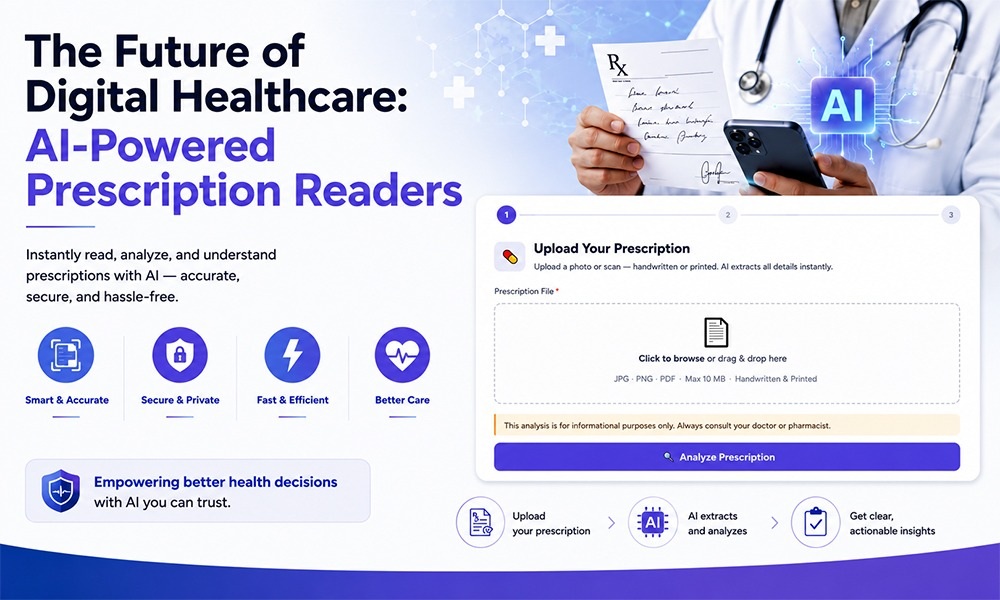
Reading a handwritten prescription is often difficult for patients and pharmacists alike. Mistakes happen when a doctor’s shorthand is misread or when details are missed during manual entry. AI-orchestrated prescription readers now change this. These smart tools instantly turn messy notes into clear digital data. By reducing human errors, these tools make medication management easier and safer for everyone involved.
Simplifying Medication Management for Patients
Patients often find it hard to manage multiple prescriptions. Keeping track of dosages, timing, and refills is a heavy burden. AI-powered prescription readers eliminate this stress by digitizing the process.
Instant Prescription Interpretation
Advanced computer vision and text analysis read prescriptions regardless of the format. Whether the note is handwritten or typed, the artificial intelligence detects the medicine name, dosage, and instructions. This speed matters because it prevents errors before they reach the pharmacy counter.
Several individuals struggle to read illegible handwriting or misinterpret abbreviations. AI tools compare the physician’s input against a database of approved medications. If a discrepancy exists, the system flags it immediately, which saves patients from taking the wrong drug.
Tools for Better Medical Adherence
Missing a dose is a major concern in chronic care. AI prescription readers can connect directly to the apps that track your schedule. When the AI scans your prescription, it automatically updates the digital calendar or medication tracker. You get alerts when it is time to take your tablet or when you need a refill. Apps like Medipedia Prescription Reader, or similar platforms, could use this data to help you stay on track, reducing the risk of complications from missed doses.
Helping Healthcare Providers With Precision
Physicians and pharmacists work under intense pressure. Automating the small tasks lets them spend more time on direct patient care.
Reducing Administrative Tasks
Doctors spend a significant amount of their day on paperwork. Studies show that for every hour a doctor spends with a patient, they spend nearly two hours on administrative tasks, including data entry. AI-powered prescription readers automate this data entry. Instead of
typing in script details, a doctor or nurse scans the paper, and the system populates the Electronic Health Record (EHR).
Boosting Diagnostic Accuracy
AI tools do more than read text. They cross-reference the new prescription with the patient’s existing health records. If a new drug interacts poorly with a medicine the patient already takes, the system sounds an alarm. This adds a layer of safety that manual checks often miss.
How AI Prescription Readers Work
The power behind these readers comes from machine learning and data analysis.
Text Recognition with NLP
Natural Language Processing (NLP) is the brain of these AI prescription readers. Standard optical scanners can read characters, but NLP can understand context. It identifies medical jargon, symbols, and common abbreviations used by most doctors. By training on millions of medical documents, the AI learns to read like a pharmacist, interpreting intent rather than shapes on a page.
Learning and Improving Over Time
These systems use machine learning to get smarter. They process vast amounts of data to adapt to different handwriting styles and prescription formats. The more prescriptions the system reads, the higher its accuracy becomes. This constant feedback loop means the technology keeps getting better, making the system more reliable for busy medical offices.
Linking with Health Records
Integration with Electronic Health Records (EHR) is the final piece of the puzzle. An AI tool is as good as its connection to the rest of the patient’s file. Developers create these tools to feed data directly into hospital systems. For healthcare IT teams, the objective is to ensure the AI prescription reader functions as a plug-in that instantly shares data with existing software, keeping all records up to date.
Ethics and Data Security
Technology in healthcare requires strict rules. Protecting your information is the top priority for developers.
Protecting Patient Privacy
Health data is sensitive. Developers must ensure that the data stored in prescription readers remains private and secure. This means encrypting all data during transmission and storage. Cybersecurity experts recommend using multi-factor authentication and strict access controls to prevent data leaks.
What Comes Next
Future AI will use predictive analytics to spot issues before they occur. By looking at trends in your prescription history, the system might determine if you are at risk of a bad drug interaction or if you like to stop taking your medication. This lets your physician step in early and adjust your plan, which helps improve your overall health outcomes. Follow Medipedia to understand how prescription readers eventually interface with genetic data. Just imagine a prescription reader that suggests a specific dosage based on your DNA.
