

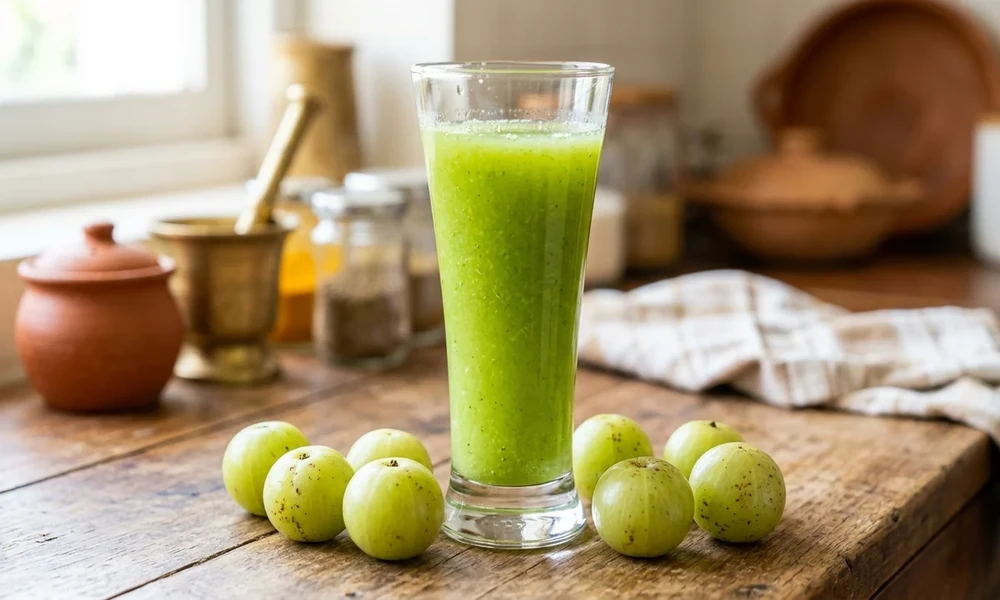
Two bottles can both say “Karela Jamun Juice” on the front and still be very different products. One might contain little beyond those two familiar ingredients. Another may combine them with several Ayurvedic herbs. The amount you take each day can differ too. More importantly, the evidence behind the finished formulation is rarely the same.
That makes choosing an Ayurvedic juice for healthy sugar support less about finding the most familiar label and more about understanding what is actually inside the bottle.
Karela is a useful example. A 2024 systematic review and meta-analysis of randomized trials found encouraging results for bitter melon on several glycaemic measures, although the researchers also called for better-quality studies. For jamun, a more recent systematic review of randomized trials described the evidence as promising but still uncertain. In other words, the presence of a well-known Ayurvedic ingredient is a starting point, not the entire case for a product. So, how do some of the better-known Ayurvedic juice options in India differ? Let us understand the best ones that are available in the market.
1. Sri Sri Tattva Karela Jamun Juice: a wide polyherbal blend
Sri Sri Tattva Karela Jamun Juice also moves well beyond a basic Karela-Jamun combination. Alongside the two headline ingredients, its formulation includes Amla, Neem, Giloy and Methi, with several other herbs forming part of the blend. The company positions it around metabolic balance and general wellness.
Its recommended routine is 30 ml with water twice a day, half an hour before meals. That makes it relatively similar to Kapiva from a daily-use perspective, although the two formulations themselves are quite different.
For consumers, the useful takeaway is not that a longer ingredient list is automatically better. It is that these products should be evaluated as complete formulations rather than as interchangeable bottles of Karela-Jamun juice.
2. Kapiva Dia Free Juice: a broader formulation with product-specific research
Kapiva Dia Free Juice takes a broader approach than a conventional two-ingredient Karela-Jamun juice.
Its formulation contains 11 Ayurvedic herbs, with Karela and Jamun joined by ingredients including Amla, Methi, Gudmar, Vijayasar and Giloy. The recommended routine is 30 ml diluted in water, taken twice daily. Kapiva positions it as part of an ongoing sugar-management routine rather than an occasional wellness drink.
What makes the product particularly relevant in this comparison is that the finished formulation itself has been studied. A published three-month clinical study of Kapiva Dia Free Juice followed 30 participants who continued their conventional medication while taking the juice twice daily. The researchers tracked fasting and post-meal glucose along with HbA1c. The study reported improvements from baseline, although it is important to note that this was an open-label, single-arm study rather than a placebo-controlled trial.
That makes Dia Free worth looking at for someone who wants a multi-herb formulation and places value on product-specific human research, rather than relying solely on studies of Karela or Jamun individually.
3. Dabur Jamun Neem Karela Juice: a more focused three-herb approach
For people who prefer a simpler formulation, Dabur Jamun Neem Karela Juice takes a more focused route.
The product is built primarily around Jamun, Karela and Neem. Dabur describes it as an Ayurvedic health juice intended to support healthy blood sugar levels, while also positioning it around metabolic and digestive wellness. The company says the juice contains no synthetic colours or flavours. The suggested serving is comparatively smaller at 10-20 ml diluted in water twice daily.
This makes Dabur an interesting middle ground for someone who does not necessarily want an extensive polyherbal formulation but would like something broader than Karela and Jamun alone.
4. Baidyanath Karela Jamun Juice: keeping the formulation straightforward
Baidyanath Karela Jamun Juice stays close to what its name promises.
The formulation focuses on Karela and Jamun, and the company positions it around blood sugar management and metabolic support. Unlike products built around a wider herb combination, the proposition here is intentionally uncomplicated.
That simplicity can itself be a consideration. Someone specifically looking to incorporate Karela and Jamun into their routine may not necessarily need an eleven-herb product. The trade-off is that ingredient-level research should not automatically be treated as evidence for every finished juice containing those ingredients. When comparing products, it is worth separating evidence for Karela or Jamun from research conducted on the bottle you are actually buying.
5. Patanjali Karela Jamun 50-50 Juice: built around the classic pairing
Patanjali Karela Jamun 50-50 Juice is another straightforward option centred on the two ingredients most consumers already associate with this category.
Karela and Jamun form the core of the product, with a recommended intake of 15-20 ml twice daily. The format may suit someone who wants a relatively simple juice rather than a wider Ayurvedic formulation.
This also illustrates why comparing products by name alone can be misleading. Patanjali and Baidyanath both offer Karela-Jamun products, while Kapiva and Sri Sri Tattva place the same ingredients inside much broader formulations.
Do more herbs mean a better juice?
Not necessarily. A longer ingredient list can allow a brand to formulate around a broader wellness objective, but the number of herbs tells you very little about whether the combination has been studied. At the other end, a simple two-herb juice may appeal precisely because it is easy to understand.
The better comparison is between the finished formulations. Look at what each ingredient contributes, how much product needs to be taken and whether the company provides evidence specifically for that formulation.
This is where product-specific clinical research becomes particularly useful. Among the products reviewed here, Kapiva’s Dia Free has a published human study on the finished formulation, rather than relying entirely on research around its individual herbs.
And what about juice versus tablets?
One practical question often comes up once people start comparing formats: for blood sugar, is an Ayurvedic juice or a tablet better? There is no universal winner.
A juice can work well for someone who likes building a wellness product into a morning and evening routine. It also allows brands to create fairly complex liquid formulations. Tablets are easier to carry and may suit someone who travels frequently or simply struggles to stay consistent with a bottle twice a day.
Kapiva, for example, offers Dia Free in both juice and tablet form. The fact that the same range uses different formulations across formats is a good reminder that the decision should not be based on “juice versus tablet” in isolation. Check the actual formulation and the recommended routine.
What should you compare before choosing?
The front label gives you the category. The back of the bottle usually tells you far more. A simple Karela-Jamun juice may suit someone who specifically wants those ingredients. Broader formulations such as Sri Sri Tattva bring more herbs into the mix. Kapiva takes that idea further by pairing a multi-herb formulation with published product-specific research. Dabur sits somewhere in between with a focused three-herb approach.
The practical question is whether the product fits a routine you can actually maintain. A twice-daily juice is only useful if you are likely to take it consistently. And when evidence is part of the purchase decision, look beyond statements such as “clinically tested.” Check whether the research was conducted on the finished product, who participated and how the study was designed.
That makes for a much more meaningful comparison than simply asking which bottle has the most herbs.
Disclaimer: Ayurvedic juices should be used as supportive wellness products and not as substitutes for prescribed treatment. Evidence for herbal supplements used in blood-sugar management remains variable, and people taking glucose-lowering medication should discuss new herbal products with their healthcare professional. The NCCIH similarly advises people taking diabetes medication to discuss herbal supplements with their healthcare provider
